Droppings on the walking path, hissing near the pond, a homeowners association fielding the same complaint every spring: a resident Canada goose flock is a specific, recurring problem, and it usually doesn’t respond to a one-time fix. Geese Chasers™ Southern Connecticut addresses it with trained Border Collie and handler teams that convince geese, through instinct rather than confrontation, that a property is no longer safe to occupy.
How Border Collies Convince Geese to Leave
The Border Collie was bred by shepherds in the border country between Scotland and England, starting in the 1700s, to stalk and herd livestock. Facing a goose, the dog crouches low, stalks, and holds a steady, wolf-like gaze, and the goose reads that as an active predator rather than a prop. No physical contact ever occurs between dog and goose, or dog and person; the method works entirely through presence, repetition, and instinct.
The Clearing Timeline: What to Expect
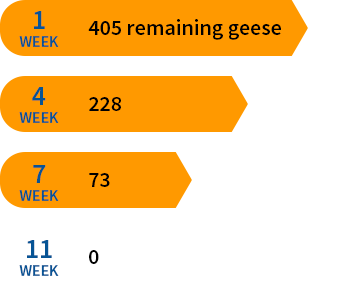
In one program tracked across the Geese Chasers™ network, a property with 405 resident geese in week one dropped to 228 by week four, 73 by week eight, and zero by week twelve, an illustrative example of how the pressure compounds over a standard Initial Clearing window. Most Southern Connecticut properties fall within that same 4-to-12-week range, depending on flock size and how long geese have been established there. After that, service shifts to either ongoing Maintenance visits or an On-Call program, with dedicated Night Runs scheduled if roosting droppings appear after hours.
Why DIY and Old-School Deterrents Don’t Last
Scarecrows, mylar tape, balloons, pop guns, and sound machines all share the same weakness: they don’t move, react, or adapt, so geese stop treating them as a threat within days or weeks. Chemical turf treatments discourage feeding on one stretch of grass but leave the rest of the property untouched. A live, unpredictable, repeated presence is the one variable that keeps working, which is why the Border Collie method holds up where static deterrents don’t.
This matters most on properties with open water, ponds, reservoirs, or Long Island Sound frontage, where geese always have a nearby escape route. A deterrent placed at one spot on the shoreline does nothing to stop a flock from simply walking to an unprotected stretch of the same property, which is why coverage of the whole site, not just the trouble spot, is part of how the initial clearing route gets planned.
Egg Addling: The Humane, Legal Way to Handle Nests
Nesting season runs from March through the end of June. When a nest is spotted before hatching, Geese Chasers™ can apply for the required state and federal permit to addle the eggs, halting development, within roughly the first 7 to 10 days after laying, given the 28-day gestation period. The parent geese typically abandon an addled nest on their own. Once goslings hatch, federal law prohibits harming or removing them, and the family stays on the property for about 70 to 90 days until the goslings can fly and the group leaves together.
Frequently Asked Questions
What does geese control cost in Southern Connecticut?
Cost depends on property size and flock size. A free site visit comes first, followed by a quote built around the specific property.
How long does it take to clear a property?
Most properties clear within 4 to 12 weeks under the Initial Clearing program, similar to the tracked example above.
Are the geese ever harmed?
No. The Border Collies herd and chase only, with no physical contact at any point.
What counties are served?
Fairfield, Middlesex, New Haven, and New London counties.
Can a nest be removed at any time of year?
No. Egg addling is only allowed within a specific early window, and hatched goslings are protected under federal law regardless of season.
What happens after the initial clearing period?
Properties move into either ongoing Maintenance visits or an On-Call program, with the option to schedule a Night Run if roosting droppings show up after dark.
Does this work on shoreline or waterfront properties specifically?
Yes, and it tends to matter more there. Waterfront and pond-front properties give geese an easy escape route, so the initial visit schedule is planned to cover the whole shoreline, not just one access point.
Why Choose Geese Chasers™ Southern Connecticut
- Locally operated by franchise owner Mike Mallek, serving Fairfield, Middlesex, New Haven, and New London counties.
- Backed by the wider Geese Chasers™ Southern Connecticut network’s long-running, tracked results in goose management.
- Multiple daily visits during Initial Clearing, seven days a week.
- Free, no-obligation site evaluation before any contract is signed.
- On-call scheduling adjusted directly by a regional manager as new sightings come in.
- Better Business Bureau accredited business.
Geese Chasers™ Southern Connecticut, led by franchise owner Mike Mallek, serves commercial, residential, and municipal properties across Fairfield, Middlesex, New Haven, and New London counties using this Border Collie method.
Ready for a free site evaluation?
Call 844-LI-GEESE (844-544-3373) or 609-410-5880 (mobile).
Advice is always free.
Geese Chasers™ Case Study
Geese cleared over 11-week program